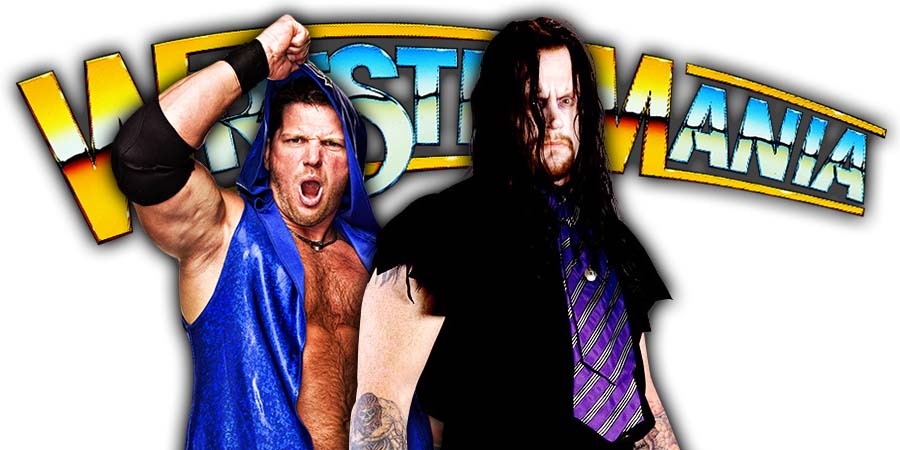
• AJ Styles Shuts Down Rumors Of Original Plan For WrestleMania 36 Match Against The Undertaker
On the Six Feet Under podcast, AJ Styles shut down rumors and made it clear that there was never a serious plan for him to face The Undertaker in a traditional singles match at WrestleMania 36, explaining that the cinematic Boneyard Match was not a late creative pivot due to the COVID-19 pandemic not allowing fans to attend the event, but the only viable option from the start. Speaking about the process, Styles framed the match as a practical decision shaped by reality rather than fantasy booking.
By the time the idea of working together gained traction, Styles said Undertaker was already dealing with significant physical limitations. Decades of wear and tear had left him struggling to get through matches, and there was a genuine concern about whether he could deliver anything close to the standard fans expected from a conventional in-ring bout. A standard match, in Styles’ view, would have risked exposing those limitations instead of protecting Undertaker’s legacy.
Because of that, the cinematic approach was treated as a necessity, not a stylistic experiment. The Boneyard Match allowed the presentation to be built around atmosphere, character, and storytelling rather than sustained in-ring motion. It gave Undertaker the ability to work within his limits while still appearing dominant, dangerous, and true to the persona he had spent decades creating. Styles has emphasized that a regular match was never seriously discussed once Undertaker’s condition was taken into account.
Styles also described the personal trust Undertaker placed in him during that period. Undertaker was cautious about returning for one more match and took time to evaluate whether he could physically and mentally commit to it. Styles understood that if the match failed, it would not just reflect on him, but on Undertaker’s final chapter. That responsibility weighed heavily, especially knowing how much the match meant to Undertaker as potential closure.
The lack of rigid planning became an advantage. Rather than mapping out every moment, the two relied on instinct and experience, letting the match unfold organically within the cinematic framework. That flexibility made it easier to adjust to Undertaker’s physical condition in real time and avoid pushing him beyond what his body could handle.
Styles was direct in pushing back on fan speculation about what an in-ring AJ Styles vs. The Undertaker match might have looked like. From his perspective, that match never truly existed as a possibility. The Boneyard Match was designed specifically to give The Undertaker a fitting final performance without forcing him into a situation his body could no longer support.
In the aftermath of filming at WrestleMania 36, Styles sensed that Undertaker knew this was the end. The timing, the physical toll, and the way the match came together all pointed toward closure. For Styles, being trusted with that moment remains one of the most meaningful responsibilities of his career, not because it was flashy or unconventional, but because it allowed The Undertaker to leave on his own terms.
• Steve Austin Reveals Why Dream Match With Goldberg Never Happened
The Austin–Goldberg dream match didn’t fall apart because of politics or creative hesitation. It never reached the point where it made sense to execute.
Steve Austin addressed the long-discussed matchup during an appearance on the Insight podcast, explaining that the idea surfaced briefly after Goldberg arrived in WWE in 2003, but stalled almost immediately due to timing.
According to Austin, there was internal consideration given to the match early in Goldberg’s WWE run. However, Austin said Goldberg was still in the process of establishing himself within WWE’s system and hadn’t yet reached the level required for a program of that magnitude.
Austin acknowledged Goldberg’s star power coming out of WCW, but noted that WWE’s expectations were different. From his perspective, name value alone wasn’t enough; the match would have required a level of rhythm, chemistry, and momentum that Goldberg hadn’t built yet in that environment.
The plan was to allow Goldberg time to acclimate, gain footing, and truly connect with the WWE audience before revisiting the idea. That window never reopened. Here’s what Stone Cold said:
“I think we pitched it when he first came in, but he wasn’t at the level that he needed to be. He had just come into WWF, and he needed to get going or get over first.
He was certainly over from his WCW days. I think a little bit of time had elapsed. Goldberg just needed to put some time in in WWF before we could go. And then it just never happened.”
Rather than being rejected or abandoned, the match simply aged out. Goldberg left WWE in 2004. On the final night of his first WWE run (which was at WrestleMania 20), Austin hit Goldberg with a Stunner.