Eric Bischoff has switched gears from a cocky industry leader to a brash, in-your-face underdog. Bischoff may come across as overly confident on TV, but he has been shaken by the WWF’s recent ratings resurgence. This week that came across on live television as Bischoff challenged Vince McMahon to a match this Sunday at Slamboree. The story behind Bischoff’s challenge, and the potential long-term and the actual short-term ramifications of the challenge, have been the primary topic of conversation within the industry in the hours since.
The actual short-term ramifications of Bischoff’s challenge are that it doubtless led to Nitro viewers switching to Raw when it began to see if McMahon would respond. It may not have been the primary reason, but it influenced Raw gaining its biggest ratings victory over Nitro in over two years — 4.8 to 4.2 in the two concurrent hours. (Nitro drew a 4.3 rating when factoring in the first unopposed hour.)
By challenging McMahon and taking shots at Sean Waltman (“X-Pac”) during the first hour of Nitro, it served as a commercial of sorts for Raw. Throughout the night in both the WWF and WCW locker rooms, wrestlers and executives were responding to Bischoff, and with a few exceptions, the dominant opinion was “Bischoff has lost it,” or “What a boneheaded move.” When the ratings came in the next afternoon and Raw beat Nitro in all eight quarter-hours, it validated those thoughts.
The past two years when Nitro was preempted from its usual timeslot for the NBA playoffs, when Nitro returned to its normal timeslot it immediately picked up where it left off with convincing wins over Raw. This year it was different. Nitro defeated Raw 5.1 to 4.4 three weeks ago, ending Raw’s winning streak (4.6 to 4.2) at one week. But in the two weeks afterward when Nitro was preempted from its usual slot, Raw drew the two biggest ratings in the history of Monday night cable wrestling (5.7 and 5.5). With Nitro head-up against it this week, Raw retained 87 percent of its viewers from the week before.
The week after Raw beat Nitro, WCW countered with a sure-fire rating draw as its TV main event — Hulk Hogan vs. Randy Savage. The strategy worked. That match drew a 6.5 rating, crushing Raw which drew a 3.8 in that final quarter, and helped Nitro gain an overall win. This week they went back to that match, but this time the result was different. Hogan vs. Savage drew a solid 4.4 rating, but Raw’s main event of Steve Austin & Vince McMahon vs. Rocky Maivia & D-Lo Brown drew a 4.7.
The impact of a match starring Austin and McMahon outdrawing a match starring Hogan and Savage — and also involving Roddy Piper, Giant, Kevin Nash, and Sting — is incredible. That means WCW can no longer rely on overwhelming the WWF simply with their star-power. WCW is going to have to work a lot harder and be a lot more creative in order to fend off Raw’s compelling storylines.
The long-term ramifications of Bischoff’s challenge to McMahon on Nitro are potentially huge. When McMahon watched Bischoff issue the challenge on a monitor backstage before Raw went on the air, his immediate response to those around him was, “He’s playing right into our hands.” He meant two things by that. One, it confirmed to McMahon that he had successfully put Bischoff on the defensive. McMahon also saw it as a ratings boost for Raw, a virtual commercial for the McMahon-Austin-Dude Love storyline. But most of all, McMahon saw it as a huge coup for his lawsuit against WCW. By challenging McMahon to face him on pay-per-view, Bischoff may have been “confusing the marketplace” by giving the impression that if you order WCW’s PPV, you might get to see Bischoff vs. McMahon.
Bischoff was apparently aware of that, since he went out of his way to tell viewers — as soon as he issued his challenge — not to buy the PPV merely for that reason since McMahon wouldn’t have the guts to accept the challenge. However, whether or not that disclaimer would be enough to negate any legal problems, when Bischoff’s challenge was replayed a total of three times during the last two hours of Nitro, they left out Bischoff’s disclaimer. McMahon was in a good mood the rest of the night because he realized he had gotten to Bischoff, who just over a month earlier had talked about how the WWF wasn’t competitive enough to make Monday nights fun.
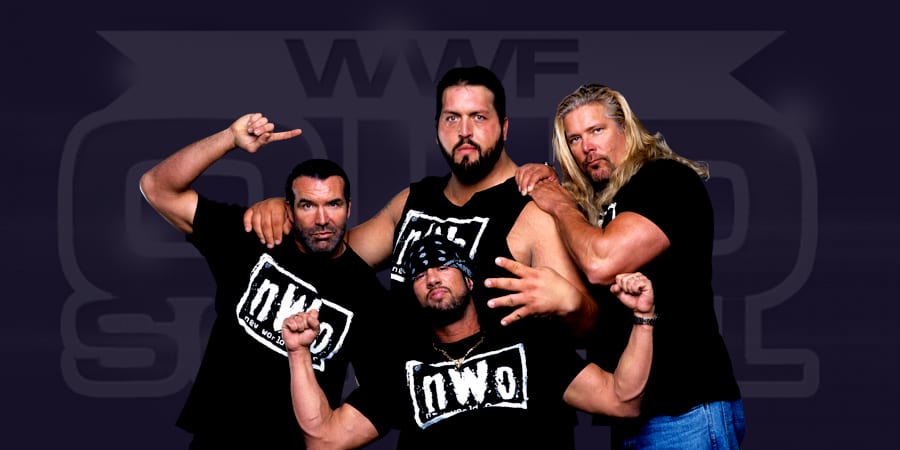
In a surprise move at Slamboree on Sunday, Bischoff succeeded in getting Scott Hall to agree to turn on Kevin Nash. In the main event, Hall knocked out Nash with the WCW tag title belt (giving him a legitimate concussion in the process) leading to Sting & Giant capturing the tag titles. Hall and Nash were vehemently against splitting up their act, but Bischoff pushed hard enough that Hall and Nash were in danger of breaching their contracts. Rather than end up where Ric Flair is, in the middle of a lawsuit with no paychecks coming and no option to join the WWF until that lawsuit is settled, they went along with the storyline.
Bischoff, in selling the idea to Hall and Nash, said that WCW needed to shock viewers to get some momentum back on their side. Besides Hall’s turn, Giant and Bret Hart also recently turned heel, while Nash has joined forces with Sting. Historically bookers resort to rapid-fire turns when business takes a downturn. In this case, WCW is resorting to rapid fire turns to attempt to spark interest in a still highly rated Nitro program, but a show that has fallen into second place the last six weeks with signs of declining momentum.
Bischoff’s on-air personality also took some strange turns as at the Slamboree pay-per-view he played up his challenge to fight McMahon and portrayed himself as the babyface. The next night on Nitro, he portrayed himself as a full-fledged heel regarding his McMahon feud.