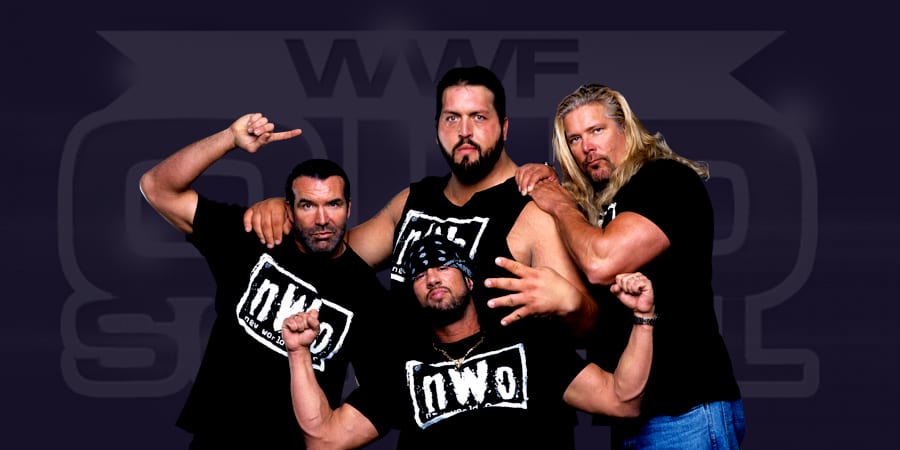
PART 13
nWo History – Part 13
Good entertainment sometimes takes time and effort to appreciate. Bad entertainment sometimes takes time and effort to begrudge. By the end of what Vince Russo declared the biggest two days of his WCW tenure, there was a lot to begrudge and very little to appreciate.
Russo’s convoluted storyline at least had an end-point from which all of his future major storylines will launch. He reformed the NWO with the core four being WCW Champ Bret Hart, WCW tag champs Kevin Nash & Scott Hall, and U.S. Champ Jeff Jarrett. Yes, it’s a rerun from the Eric Bischoff era, a rerun of a once successful angle that had been driven into the ground by the time it was retired earlier this year.
It is not a positive sign for Bill Busch that Vince Russo’s first big concept idea was to feature himself as the centerpiece of the promotion, and his next big concept idea was to revive the NWO.
There are a lot of things disturbing about Russo’s tenure in WCW, and never were they more prominent than on Sunday and Monday. He was very aware of his strengths when he came to WCW, but what is killing him is his inability to acknowledge or overcome his weaknesses.
Starrcade featured some matches that should have never taken place (Sid vs. Nash, Duggan vs. Varsity Club), new talent that has no chance of helping the company (Mike Rotunda, Kevin Sullivan), and a finish that will go down as perhaps the biggest ripoff of all time. The non finish with no attempt to explain it to viewers afterward ranks up there with the Great American Bash ’88 finish where the Athletic Commissioner stopped the Ric Flair vs. Lex Luger match due to a trickle of blood on Luger’s forehead.
Ironically, the bad finish will be remembered for a long time, just like the finish it was attempting to emulate or draw upon. The Survivor Series ’97 finish where Vince McMahon swerved Bret Hart out of the WCW Title against Shawn Michaels was what inspired Starrcade’s finish. Tony Schiavone went so far as to say on Nitro the next night, “The reason that Goldberg was screwed last night was because Vince Russo wanted to make up to Bret Hart what happened two years ago in Montreal.”
After three refs went down, Roddy Piper came to the ring in a referee shirt. He walked into the ring as Bret applied the Sharpshooter on Goldberg. He called for the bell without even checking on Goldberg’s state of mind, and then he walked away with the title belt. None of it actually made sense. It did not accomplish Russo’s ill-conceived goal of trying to portray the situation as a “shoot.” It came across as a teaser – and a bad one at that – for Nitro the next night.
Russo wanted to create a cliffhanger. The next night on the WCW Live Internet show, he admitted to sacrificing Starrcade’s finish in order to conclude his angle the next night on Nitro. He seemed somewhat apologetic that it played out that way. The rating for Nitro didn’t indicate much of a buzz coming out of Starrcade. The Dec. 20 Nitro drew a 2.9 rating, one-tenth of a point higher than last week, but exactly the average rating for the previous ten weeks. The work/swerve gimmick may be a self-indulgent form of entertainment for bookers and wrestlers, but wrestling fans are not interested.
Good TV shows, movies, and books are entertaining because the plot is engrossing and the characters are intriguing. Russo is trying to get by on shock value and on exposing as much of the inner-workings as possible
Russo imay be going back to what got him to the dance in the first place. Before Russo took over editing WWF Magazine, its articles were for the most part worked. There was little inside information. He changed that. He broke from tradition and used real names in his articles, he told readers secrets and used terminology readers had never seen in the magazine, and he wrote about aspects of the wrestling business that the WWF tried for years to hide. It worked for him at the magazine.
That approach does not translate to wrestling booking. He is trying to do the same thing with WCW. He called himself a “scriptwriter” instead of a “booker,” which was supposed to earn goodwill with fans who said to themselves, “Hey, this guy is admitting there are scripts!” He had wrestlers talk about management on the air. He was supposed to gain the trust of viewers by admitting the small things were works so that he could get away with pretending the big angles were shoots. That was the trick with WWF Magazine. If you tell the readers the truth on small things, they will believe the big lies (be it drug deaths, media scandals, or the whole sponsorship/adult content controversy).
When Russo brought that philosophy to WCW TV, fans were confused by how poorly executed the whole concept was. They certainly didn’t buy into anything being a work.
By the end of Nitro, Russo may have bought himself a fresh start. The Powers that Be gimmick is going to be phased down or out. He has established a top group of heels. WCW sorely lacked any heel presence, outside of Jeff Jarrett, leading into this weekend. He also has Ric Flair returning, who usually sparks a ratings increase for a few weeks before internal forces begin to sabotage him for fear that he will steal their power or top position.
Bret Hart is a better heel than a babyface simply because his overly pristine babyface approach doesn’t have a lot of flexibility or appeal for a top star in this era. As a heel, he generally has enough contempt for what wrestling has become that he will be believable. Hall and Nash now need to commit themselves to doing something very important for the company – be heels, not too-hip-for-the-room tweeners who don’t draw money, only crowd pops at the expense of the babyfaces they are feuding with.
Russo needs to regroup. What he has been doing hasn’t been working. He is still working on getting more freedom from upper-management to portray adult themes and angles, but until he shows an increase in ratings, he won’t be given that slack.